Cross posted on NewRaleigh.com Happy Spring, all.
It's time for birds and bees and flowers and trees, and sadly, a lot of pests too. Nothing says spring quite like looking down the loooong aisle of pesticides at the hardware store, sigh.
But, if you stick with me, I will do my best to get you through the spring insect onslaught without having to resort to toxic and expensive pesticide products! Drop me a line in the comments, or on our website, to request a toxic free tip about your favorite pest.
Which brings me to today's main dish: ANTS.
Flippin' ants. They come in all different sizes, shapes, and levels of annoyingness.
For ants that wander indoors, I've heard lots of natural remedies involving cinnamon or cayenne pepper, but can't vouch for those myself. I have a feeling, though, that no remedy natural or otherwise is going to get rid of ants unless you remove their food source. Like any other pest, ants wander inside to eat something you've got there - often something sweet and delicious in your trash or your cabinet. So, cleaning up and putting foods into ant-proof containers is key. By ant-proof, I mean airtight plastic and glass containers - plastic bags or boxes won't hold against a determined ant!
So, Billie's indoor ant management program goes something like this:
Step one: kill ants.....with soapy water. Let's say there's a train of ants moving through your kitchen. The quickest and most satisfying way to quell the insurgency is to squirt them with soapy water, then wipe them up with a sponge or rag and send them down the drain. They will drown, and what's more, you will clean up the pheromone trails they leave for each other. The "scout" ants leave a trail for the rest of the gang to follow and find your sweet treats, so wiping that up slows them down. *Note: don't wipe up the whole trail before you figure out where it starts, i.e., where they're coming in from, because that is useful information!
Step two: block the way the ants came in. If there's an obvious crack or hole they're using to come in, block it off. A permanent fix is ideal - like caulk or a screen - but anything will do for a temporary solution....even duct tape.
Step three, get rid of all your crumbs and sticky bits. Everyone's kitchen has some. Find them and clean them up! With soap! Then, it's time for the ant-proof containers, as per above. Another quick fix if you don't have enough ant-proof jars/bins/etc: your fridge is a giant ant-proof container, so you can temporarily keep boxes and bags of ant-prone foods like cereal, sugar, or dried fruit in the fridge.
Step four, if all that wasn't enough to foil your ant friends, it's time for some borax ant bait you can mix up yourself. Borax isn't non-toxic, but it's a heck of a lot closer than the bug sprays you can buy at the store, it doesn't off-gas, and it's wicked cheap. You should still handle it with care, and be sure that your borax ant baits are labeled, and kept well out of the way of kids and pets. To make the bait, dissolve 1 cup of sugar and 4 teaspoons of borax in 3 cups of water. Divide the mixture between several small containers that you don't mind ruining - old jelly or baby food jars, little plastic containers, or whatever. Loosely pack the containers halfway with cotton balls or other cotton stuffing. Put the lids on, then poke a few holes in the top of each for the ants to get in. Then, put the bait containers near places where ants are getting in, or near where they've been visiting a lot. It may sound weird, but these baits really work!
For more advice on getting rid of ants, check out these articles from Toxic Free NC: Getting Rid of Ants Without Toxic Chemicals, and The ABCs of Coping with Fire Ants.
Thursday, April 8, 2010
Flippin' Ants

Wednesday, March 24, 2010
gardeners' tool: what's in your fertilizer??

The bag directed me to the company's regulatory website to read about the ingredients. That website directed me to this one: The Washington State Fertilizer Product Database. Hot dog!!
I looked up the "for organic gardening" fertilizer and discovered that it contained 37.9 ppm arsenic. Arsenic! Just to put that number in perspective, the EPA's arsenic limit for drinking water is 0.010 ppm. That makes the fertilizer levels more than 3,000 times higher than the EPA's limits for drinking water. It was also full of mercury, cadmium, lead, and plenty of other stuff that doesn't belong in my vegetables. And I want to put this stuff on my garden.... really?
Luckily we have a nice big compost pile in our backyard full of rich organic matter for the garden. We returned the bag of fertilizer (and told the store why we were returning it - they were a bit taken aback).
The good news is that you don't need to buy fertilizer additives for your garden - compost is easy to make at home. The bad news is that fertilizer is full of virtually unregulated contaminants. The Washington State database lets you find out what's there - but only after you've bought the stuff. The USDA should crack down on fertilizer makers. The rest of us can learn about organic gardening and make our fertilizer the do-it-yourself way.
Monday, January 25, 2010
Infestations Vacations
goofy but great home pest prevention video from US EPA
Thanks to Toxic Free NC board member Dr. Katherine Shea for sharing this link! The EPA recently released this funny little video - Infestations Vacations - together with a set of recommendations about preventing home rodent infestations. It's right on for preventing a lot of other home pest issues, too!
Rat poison - a.k.a. rodenticides - can be so dangerous, for kids, pets and a lot of non-rodent critters, so this is especially needed. Nice work EPA! Sorry it's not easier to share - that's EPA's fault, not ours. You can download copies of the video from their website pretty easily, though.
Monday, December 22, 2008
Sustainable Holidays: Minimize the Meat
The holidays can get stressful. Whether driving long distances to see family and friends, preparing a meal for 10 or just trying to find a gift for everyone on your list, the holiday season can be hard work!
The more I learn about the meat industry, the less I want a roast to sit at the center of my table, let alone the center of a family member’s stomach. Nothing says love and care like hormone-injected beef or some factory farmed chicken, right? So where does this leave me, and all the others staring at the hole in the table? It leaves us with a chance to reevaluate our eating habits and bring fresh ideas on food into the new year.
More than two years ago, I made a big step toward a healthier lifestyle by choosing to give up meat all together. During this time, I learned the value of spices and the immense variety of vegetables and fruits we can enjoy. It also gave me more respect for the farmers that grow it and a careful eye for picking out the best produce. It brought me to farmer’s markets in mid-summer to pick the juiciest heirloom tomatoes and showed me how to create something delicious when someone handed me a rutabaga. The journey brought me many places and my views changed constantly, evolving with all that I learned. One thing that has consistently resonated within me is a deep respect for life and a strong connection to the Earth. This respect has made me rethink the role of meat in our diets, at the center of our tables and as the largest portion on our plates.
Americans eat far too much meat without even realizing it. A turkey isn’t a turkey anymore, it’s a package of deli slices for lunch; chicken is drenched in BBQ sauce and conveniently microwaved for dinner. Stopping to think how much meat the typical American eats in a given day, let alone the whole week, is absurd. Meat prices are so artificially low that we can enjoy our favorite dishes everyday instead of reserving them for special occasions - like the holidays. Meat should be regarded as a delicacy, honoring the life that was given so you may enjoy it. It used to be a smaller part the meal. It wasn’t the whole dinner and it certainly wasn’t the meat most of us know today.
So this year, as you stare at the hole in your holiday table, think of what you are thankful for. Think of what you are celebrating or whom you are honoring. If you do eat meat, respect the animal and yourself enough to buy it from a local farmer who raised it on open pastures instead of in a CAFO (Concentrated Animal Feeding Operation). Check out LocalHarvest.org to find a farm near you. And make sure to try out some new recipes like the ones below. I can personally attest to the harvest stuffed squash from chooseveg.com; it was a big hit during Thanksgiving!
Alternative holiday recipes:
http://www.chooseveg.com/stuffed-acorn-squash.asp
A complete vegetarian Christmas dinner:
http://www.theveggietable.com/recipes/christmas.html
- Guest post by Christopher Grohs, Toxic Free NC Volunteer
Thursday, October 30, 2008
Get out there and vote!
Vote early by this Saturday or vote Tuesday November 4th
Get all your voting questions answered at: www.ncvoterinfo.com
With national and state candidates crisscrossing the state, it's clear that North Carolina is headed for a historic level of voter turnout this year. Don’t be left out! You have two options for voting in North Carolina:
1. Vote on Election Day next Tuesday, November 4th . The polls open at 6:30AM and close at 7:30 PM. Find your precinct at the State Board of Elections website.
2. Vote early through this Saturday November 1st. Early voting gives you added flexibility to vote when you have the time rather than trying to fit it in on Election Day. Find your early voting locations and times here. Remember that you can go to ANY of the locations listed in your county.
Early voting is also your last chance to register and vote in North Carolina for next Tuesday’s election. If you’ve moved since you last voted then you need to re-register through early voting. You can also check your current registration status, or contact your local board of elections for more information.
Make sure you know who you’re voting for: go to the State Board of Elecitons site and click on the link for “General Election Sample Ballots.” You can get additional voting questions answered and see bios of the candidates running for state office with this non-partisan voter guide (this is a pdf file download).
Here are some additional resources for other voting and election questions or problems:
- NC Voter Info.com
- Democracy NC's Election Connection
- Or call 1-888-OUR-VOTE
And make sure your friends and family have all the info they need to vote in North Carolina!

Tuesday, September 23, 2008
Fall eating
 The crisp, cool mornings and shorter evenings are a sure sign of autumn. And so are the beautiful piles of pumpkins, sweet potatoes and winter squash that are beginning to appear in farmer's markets all across North Carolina.
In my house, cooler weather means more cooking, now that it's finally okay to turn the oven on again after a few long hot summer months of melon slices and tomato sandwiches. The garden is leafy and green again, with little chard, kale and lettuce plants soaking up the warm, sunny afternoons. And soon it will be time for boxes of shiny apples, especially my very favorite, Honey Crisp.
If you thought the end of summer meant the end of fresh fruits and veggies from the farmer's market, think again! Many markets stay open right up to Thanksgiving, and some even longer. You may not have known that there was such a thing, but some farms are now offering winter CSA shares to keep you in vegetable heaven all through the cooler months. Check the CSA listings at Growing Small Farms to find one near you.
To get you dreaming of fall culinary delights, here is a recipe for Baked Winter Squash from Toxic Free NC's farmer's market recipe archive:
Baked Winter Squash
by Susan Spalt
- Any kind of winter squash (butternut, acorn, spaghetti squash, etc)
- Butter
- Worcestershire sauce
- Brown sugar
- Grated cheddar cheese
Cut squash in half. Wrap in foil and bake at 350 until tender. Remove from foil. Carefully scoop out squash, saving the skins. Combine squash with 1/2 tsp. butter, about a tsp. Worcestershire sauce, and 1/2 tsp. brown sugar. Place back in skins. Sprinkle with grated cheddar cheese. Bake for 10 minutes or until cheese has melted.
Friday, September 5, 2008
Community Organizing 101: Building community, strengthening democracy, and getting things done.
It's true, most people don't know what the heck I mean when I say that I'm a community organizer. But even though the term is unfamiliar, I think most people would readily recognize "organizers" in their own communities as leaders and connectors - the proverbial "movers & shakers." Anyone who's ever put together a community event like a fundraiser, service project, strike, boycott, or protest; started a new club, organization, union, or other group; asked people to sign a petition, contact their representatives, speak at a public meeting, or vote for a certain person or proposal was probably doing some community organizing.
Community organizing encompasses a really broad range of activities and issues, and many different kinds of people do it. Some are volunteers or concerned citizens, while others do it professionally; some do it as part of a congregation or organization, while others do it independently. But there are a few common threads that I think are the most important parts:
1. Making changes & getting things done. At the most fundamental level, community organizing is a process by which people get together - "organize" - to get something done. This could be changing a rule or policy, getting someone elected, starting a new group or program, stopping something hurtful to the community, or starting something needed and helpful. Whatever it is, people come together to make a plan and then do it together.
2. Community. Communities of people are built and strengthened by the process of community organizing. When a good organizer runs a campaign or project, the community is stronger when it's over, regardless of whether they actually won or accomplished the original goal. The people involved have built relationships, skills, knowledge, and confidence that make them more active and effective participants in their community, and make future community organizing projects easier and more successful.
3. Power, Equity and Democracy. In theory, a democratic process means that people who are affected by a particular decision get a equal say in how it's made, or at least an equal say in who gets to make it (i.e. through electing representatives). But in reality, that is often not the case. The dynamics of power, privilege, and profit in our society mean that the system isn't always fair, and some people can't get what they need through normal channels. Maybe they can't get pollution out of their air or water, can't get their child's public education improved, or can't get a fair living wage. Community organizing helps to correct injustices and fix an inequitable system by bringing people together to exercise their power as a voting block or a customer base, and demand the changes they need.
In our work at Toxic Free NC, this shows up as parents who want to get their schools or childcare centers to stop using pesticides, farmworkers or farm neighbors who don't want to be sprayed, consumers who want better access to food grown without pesticides, and lots of other things too. So, we work with these groups of people to help them get what they want, and in the process we build community and correct imbalances of power that create injustice and weaken our democracy. It's pretty heady stuff, and we're proud to be doing this important work in North Carolina.
Interested in getting organized in your community, and reducing pesticide pollution? We're here to help - please contact us!
Interested in becoming an organizer? It's a pretty great job, if I do say so myself. Here are a couple of my favorite resources:
Midwest Academy
The Community Toolbox
PS: I really like this quote I just found from Mike Miller of the Organize Training Center:
Organizing does two central things to seek to rectify the problem of power imbalance - it builds a permanent base of people power so that dominant financial and institutional power can be challenged and held accountable to values of greater social, environmental and economic justice; and, it transforms individuals and communities, making them mutually respectful co-creators of public life rather than passive objects of decisions made by others.
Thursday, June 19, 2008
It's fire ant season in NC
I got stung by several fire ants last week while wearing sandals in a vegetable garden. Besides the usual pain and surprise, my foot and ankle swelled up for a couple days following. Augh....happy summer, I guess. The bites were timely, actually, since I've been working on an article about least-toxic control of fire ants for the summer edition of Toxic Free News (due out in July, stay tuned!). But, I wanted to post a few tips on fire ants now, in case you (like me) are already dealing with these nasty buggers....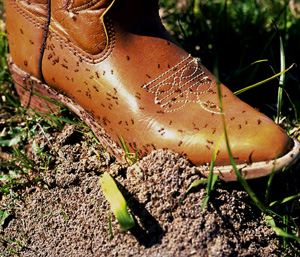
- Fire ants like to eat trash and drink water from leaky pipes and puddles, just like so many other pests. Keep your outdoor trash and recycling areas tidy, clean up food scraps left after picnics and cook outs, fix leaky pipes and correct drainage issues around the house.
(Image caption: Fire ants swarming a cowboy somewhere in TX. Photo courtesy of Texas A&M University.)
- Lots of other ant species will fight and kill fire ants - they're competitors! So, when trying to get rid of fire ants, don't go crazy and kill other kinds of ants, since they may actually be helping you.
- Mark fire ant mounts with a flag or something else bright and eye-catching, and warn people to avoid them. Fire ants only bite when their nests are disturbed, i.e. by stepping on them. They won't come looking to bite you if you stay out of their way!
- The least-toxic, and most-often-cited strategy for fire ants is plain old hot water. Some sources recommend mixing in a little soap, but either way, it's 2 or 3 gallons of hot water poured slowly over the mound. This drowns many of the ants, and annoys the rest of them enough that they move their nest elsewhere. You might have to do it 2 or 3 times over the course of a week to finish them off.
- And of course, the pretty obvious thing that I forgot when I was in the garden last week: wear socks and shoes, or better, rubber boots (or cowboy boots?!) when working in areas prone to fire ants.
That's all for now! Check out this article from the Toxic Free News archives - it includes a description of the "yellow flag system" used to control fire ants at Elizabeth City public schools. And stay tuned for my article on fire ant management coming up in the next issue of Toxic Free News!
Wednesday, March 5, 2008
Local & Organic Food on NC Campuses - Advances in Food Democracy
There's an exciting (and delicious) trend afoot: college campuses in North Carolina are turning to locally-produced, organic foods for their dining services and on-campus restaurants! To get up to speed on what Triangle campuses are doing, check out this great article in last week's IndyWeek about the "FLO Food" movement at UNC, and similar efforts at Duke and NCSU.
Across the state, students and staff at colleges and universities are working on getting their own dining halls to go local and organic, and it's not just the crunchy colleges you might think of first, either! This is really exciting to me for a lot of reasons, but to sum up the highlights -
If a college campus can do it, just about anyone can. At the top of the list of reasons why people don't eat local and organic food, you'll probably find things like "it costs too much," or "it's hard to find," or, for large-scale kitchens, "there's not a large and consistent enough supply for what my restaurant/school/etc needs." But, goshdarnit, if a university dining service that makes thousands of meals a day can do it, than so can just about anyone! I think our NC university dining services are dispelling some important myths about buying local and organic food:
> It doesn't necessarily cost more, and when it does, it's often worth it. I like the example of the hamburger made of local grass-fed beef that costs $1 more, but students buy more of them anyway because they taste better and it's the right thing to do. If you're truly strapped for cash, that $1 really might not be worth it, but I think a lot more people could, and would, make that choice if they had the option.Most of all, this article makes me happy because it's about democratizing good food. By that, I mean that everyone deserves the choice to eat healthy, locally-grown organic food, not just people who live near natural foods stores, and not just wealthy people. When large institutions that serve a broad cross-section of the community commit to providing these options, that's a huge step in improving our food democracy! Where else do we need to see more local and organic food options?
> You don't have to buy everything local and organic for it to count - start somewhere! According to this article, dining services at Duke are serving between 16% and 35% local foods, depending on the place. That's fantastic, so long as they're not misleading anyone to think that it's more than what it is. As consumers, we have to be like the Duke dining hall - we have to buy as much local and organic stuff as we feasibly can, and trust that with time, it'll get easier. Any business we can consistently send to local and organic farms helps our local economy, environment, and our own health. With a little time, the supply side of the equation will catch up to us, and we'll be able to find more affordable local and organic foods.....but we've got to start buying what we can now!
> It's not just fancy stuff, and it's not just veggies. Nope, "organic food" does not just mean shitake mushrooms, sprouts and broccoli rabe (say what?), and it doesn't just mean something you eat at a fancy restaurant for special occasions. It also comes in normal everyday varieties....your green beans and your mashed potatoes, your carrot sticks and apple juice. And, it's not just your fruits and veggies that come locally produced and organic - it's also meats (pork, beef and poultry), eggs, milk and cheese, honey and more. Heck, it's even your Christmas tree! All these products are available organic and North Carolina-grown, so please don't forget to look for them!
K-12 schools!
Childcare centers!
Office & hospital cafeterias!
Your regular grocery store!
Where would you like to see more local or organic foods? Need help making a plan to get them? Please don't hesitate to contact us!
Thursday, December 13, 2007
Taming termite terrors, plus some concerns over chlordane contamination
 A pest to fill every homeowner with dread - termite!!
So, one big question I have is this: Since the buggers were in my house before, it must have been prone to infestation in some way, and may still be. How can I prevent future problems, without resorting to pesticide treatments?
So, I checked out Beyond Pesticides' factsheets on alternatives to pesticides for termite control, and particularly liked this article - Taking the Terror Out of Termites (link downloads 152 kb PDF file). You can check it out for their recommendations. In a nutshell, termites like moist wood, so moisture reduction is a major component of preventing termites. And, there are several least-toxic and non-toxic treatment methods available, so a chemical arsenal really shouldn't be necessary.
Another big question on my mind has to do with the past infestations in my house, and how they were treated. This house was built in 1950, and I have no idea when termites were an issue in that nearly sixty-year history. From 1948 to 1988, a common method of treating termites in the US was a chemical called chlordane, an organochlorine pesticide related in structure to the likes of DDT, aldrin, lindane and endosulfan. Chlordane was applied to the soil around and under the house to act as a chemical barrier to wood-boring insects. It was banned for use on food crops in the US in 1978, and for use as a termite treatment in 1988, due to rising concern over health and environmental impacts. Exposure has been linked to increased risk for a host of health problems, including some types of cancer, neurological problems, and fertility disorders. A really worrisome finding from an article in today's Vancouver Sun:
"(...) Researchers found people with the highest levels of a certain type of insecticide in their blood had 2.7 times the risk of developing non-Hodgkin lymphoma as those with the lowest amounts.
That strong link involved a metabolite of the insecticide chlordane. (...)"
Some highlights (or lowlights, in this case) from the ATSDR public health statement for chlordane (emphasis is all mine):
"Chlordane is known to remain in some soils for over 20 years. Persistence is greater in heavy, clayey or organic soil than in sandy soil."Oh no! So along with all the fumes from the glues, finishes, paints, and carpet in my house, I may also be breathing fumes from pre-1988 chlordane treatments that are seeping up through my floorboards! I'm trying not to panic - after all, stress is bad for your health, too, and every house I've ever lived in (and that most Americans have lived in!) was built before 1988 and probably carries some level of chlordane. It's a common, though no less unfortunate contaminant of the home environment.
"Today, people receive the highest exposure to chlordane from living in homes that were treated with chlordane for termites. Chlordane may be found in the air in these homes for many years after treatment. Houses in the deep south and southwest were most commonly treated."
"You may come into contact with chlordane while digging in soil around the foundation of homes where it was applied to protect the homes against termites."
Based on what I've read about chlordane and other similar chemicals, I have a few ideas for ways to reduce my risk of exposure at home, and to improve my indoor air quality overall:
- Ventilation. I've got window screens and ceiling fans, so I'm ready for lots of fresh air in the spring, summer and fall...and also on freak 80-degree days in the winter, like today!
- Cleaning - especially dusting. This could be more of a challenge - I'm not exactly a neat freak, but I understand that chemical contaminants in indoor air settle with the dust in a room onto the floor and surfaces. So, mopping and dusting regularly with natural cleaners like borax, baking soda, and Dr. Bronners soap will be helpful to get rid of any chemical residues, and to prevent cockroaches, dust mites, and a bunch of other pests and allergens too.
- Mulch. While having mulch in direct contact with the side of my home is a bad idea, since it can harbor pests and trap moisture along the foundation, laying mulch over some of the possibly-contaminated soil around the perimeter of my house is sounding like a better and better idea. I have a dog who will be spending a lot of time digging around in the dirt in my yard, and she can't exactly take off her shoes before entering the house to avoid tracking in contaminated soil! Mulching over the soil that's most likely to be contaminated could be a good way to prevent her from digging in it and tracking it in, and will also help to keep down weeds.
- Soil mitigation. I'm planning for a little herb and vegetable garden in the backyard, not too far from the back wall of the house. I might need to get a soil test to check for chlordane contamination before planting edible plants, or at least put in some relatively "clean" compost or topsoil to reduce contaminant levels in the soil.
I'm going to keep looking into both questions over the next couple months, and will report back with my findings and keep you all posted on what I end up doing. In the mean time, I'd love to hear your thoughts on the matter, and any tips you have for either preventing termites without toxic chemicals, or for getting chlordane and other chemical contaminants out of my home and garden. Please leave me a comment with your suggestions. Thanks!
Tuesday, November 20, 2007
organic holidays
This week, as we gather with friends and family to give thanks for life's blessings, we also begin a frenzied holiday season. Chances are, the Thanksgiving holiday has got you thinking about gifts, parties, holiday baking and decorating, and a million more to-do list items. We've put together some resources to make your to-do list a little more sustainable, starting with organic Christmas trees:
Looking for an organic or sustainably-grown Christmas tree or wreath? Look no further than PESTed's annual guide, a great place to start your search.
PESTed also has a great archive of recipes for locally-grown North Carolina produce. Check out these tasty concoctions like sauteed collards, baked winter squash and apple crisp. Most of these great recipes come from our friends Anne Everitt and Susan Spalt, who both draw their ingredients lists from the Carrboro Farmer's Market.
Bloggers from around the environmental community are compiling resources for sustainable holiday celebrating and gift-giving this year. Check out this great sampling:
- Durham blogger Shari of The Glass Doorknob interviewed different artists each day last week, with links to their hand-made items to inspire your holiday gift list;
- The NC Conservation Network is planning a green-holiday blog post for later this week;
- Ethicurean just posted their vegetarian Thanksgiving favorites;
- Treehugger has an annual Green Gift Guide.
Happy Thanksgiving!
Friday, May 4, 2007
Composting with worms
While on a jaunt in Charlotte week before last, I was lucky enough to receive my very own worm bin for vermicomposting kitchen waste. (Thank you Chris North!) This has sparked several realizations on my part:
1 - Vermicomposting is really easy. I can't believe I didn't start doing it sooner. Basically, you make a ventilated bin (putting a few holes in the side of a plastic storage bin works well), load it up with dirt and bedding material (I started with shredded newspaper), keep everything about the dampness of a wrung-out sponge, add worms, and add kitchen scraps (about 1/2 pound a day, or 3 - 4 pounds a week), and presto! You're vermicomposting! There is little or no smell, the worms are totally contained and need very little extra care, save the periodic addition of your food scraps, and some moisture maintenance. Before long, you'll have a bin full of worm castings (i.e. worm poo, but don't worry, it doesn't smell!) that is an excellent fertilizer for potted plants and gardens.
2 - Your town and county probably have resources to get you started. Many NC municipalities (including Charlotte and Raleigh) have programs in their solid waste departments that promote and support vermicomposting. NC Cooperative Extension also has vermicomposting workshops and information. Check out your town website, or your local cooperative extension office, to see if there are programs in your area that you could be taking advantage of to get a cheap or free worm bin, or a starter supply of redworms.

Above, my dog Indiana makes friends with her new roommates, the redworms.
Have a good time. :)
